

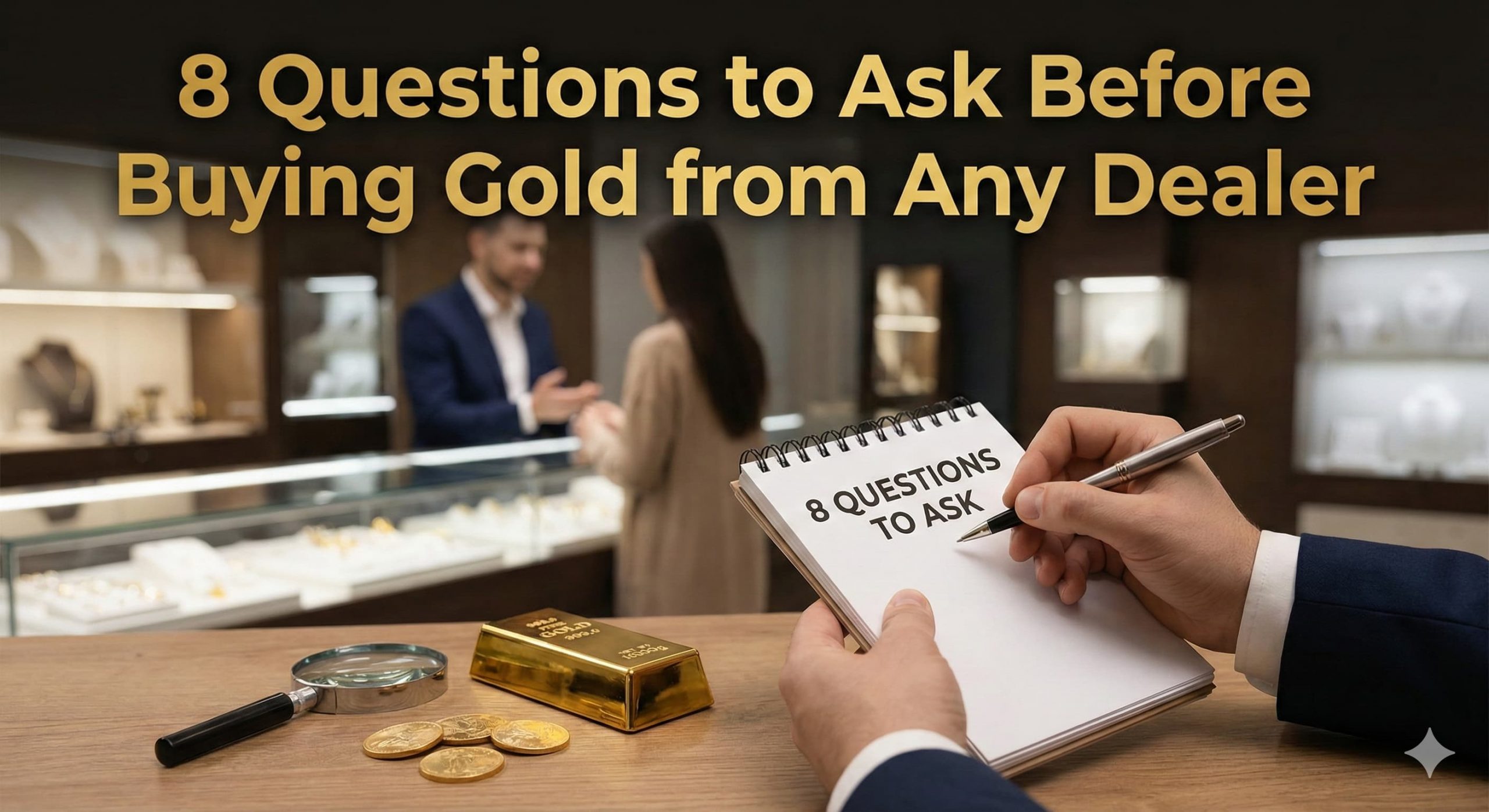
Buying physical gold is not like buying a book or a pair of shoes. You’re handing over real money — sometimes a significant amount of it — in exchange for an asset whose value depends entirely on its authenticity, quality, and the reliability of the person selling it to you. The precious metals industry is overwhelmingly made up of legitimate, professional dealers. But there are enough bad actors, grey-area operators, and simply underperforming businesses that walking in unprepared is an unnecessary risk.
The good news is that a handful of direct questions will tell you almost everything you need to know about a dealer before you commit to a purchase. Ask these eight before you buy from anyone — including us.
1. Are Your Products from LBMA-Approved Refineries?
This is the single most important question you can ask, and the answer should be immediate and unambiguous: yes.
The London Bullion Market Association (LBMA) maintains a “Good Delivery” list of approved gold and silver refineries whose bars meet rigorous standards for purity, weight accuracy, and chain of custody. Bars from LBMA-approved refineries — including Valcambi, PAMP Suisse, the Royal Canadian Mint, Perth Mint, and Rand Refinery — are accepted at full market value by banks, institutional buyers, and dealers worldwide. They are the global standard for investment-grade bullion.
If a dealer sells bars from unrecognized or unapproved refineries, those products may be harder to resell, could carry authentication questions, and will often trade at a discount to LBMA-approved equivalents when you try to liquidate. The bars might contain exactly the gold claimed — but without LBMA approval, you’re relying on trust rather than a globally verified standard.
What a good answer sounds like: the dealer names specific refineries (Valcambi, RCM, PAMP, Perth Mint, Credit Suisse) and can confirm they are LBMA-listed. If they respond vaguely or can’t name the refineries their products come from, keep shopping.
| LBMA-Approved Refiners to Know | Country | Known For |
|---|---|---|
| Valcambi Suisse | Switzerland | World’s largest refinery; 999.9 purity |
| PAMP Suisse | Switzerland | Iconic Fortuna design; security features |
| Royal Canadian Mint | Canada | Serialized bars; advanced anti-counterfeiting |
| Perth Mint | Australia | Government-backed; 9999 fine gold |
| Rand Refinery | South Africa | Historic refinery; largest integrated precious metals facility |
2. How Is Your Pricing Calculated — and Can I See It Before I Commit?
Transparent pricing is one of the clearest signals of a reputable dealer. Gold and silver spot prices are publicly available and update in real time on global exchanges. A trustworthy dealer ties their prices directly to the current spot price, adds a disclosed premium, and shows you the total before checkout — with no last-minute add-ons or sudden changes at the point of payment.
The premium is the dealer’s markup above spot. It’s legitimate and necessary — it covers the cost of the product, distribution, storage, and the dealer’s margin. What varies is how much that premium is and whether it’s disclosed clearly upfront. Red flags include:
- Prices quoted without reference to the current spot price
- Premiums that change between when you inquire and when you pay
- Fees disclosed only at checkout (processing fees, “handling” charges, mystery surcharges)
- No live pricing on the website — prices only available “by request”
A good dealer will show you spot price, premium, and total delivered cost in one clear number — and that number won’t change by the time you check out. It’s also worth asking whether paying by bank wire versus credit card affects the total, as many dealers charge a processing fee (typically 2–3%) for card payments. That’s reasonable — just make sure it’s disclosed before you choose your payment method.
3. Is My Shipment Fully Insured During Transit?
Physical gold has to get from the dealer to you somehow, and transit is one of the most vulnerable points in the chain. A professional dealer insures every outgoing shipment for the full replacement value of its contents, from the moment it leaves their facility until you sign for it at your door.
Ask this question directly and get a direct answer. “We use a reputable courier” is not the same as “every shipment is fully insured.” You want to know:
- Is the shipment insured for the full value of the contents?
- Who is responsible if the package is lost or damaged in transit?
- What is the claims process, and how long does it take?
- What happens if the package is marked as delivered but never received?
Shipping insurance ends the moment you sign for the package — which means you should always refuse delivery of any parcel that appears tampered with or damaged before signing. A dealer who doesn’t offer full transit insurance is transferring that risk to you the moment the package leaves their warehouse.
4. What Is Your Buyback Policy?
This question reveals more about a dealer than almost any other. The sell side of the transaction — when you eventually want to liquidate — is where many buyers get an unwelcome surprise. A dealer with a fair, structured buyback program is offering you a complete investment relationship, not just a one-way sale.
What you want to understand before you buy:
- Do they buy back what they sell? (Not all dealers do.)
- At what price — a fixed discount to spot, or market-based?
- Is the buyback price published, or negotiated at the time of sale?
- Are there restrictions on what they’ll buy back (certain sizes, refiners, years)?
- What is the process — do you ship to them, or bring it in person?
The spread between a dealer’s buy price and sell price is how they generate margin on both sides of the trade. A reasonable spread on a 1 oz gold bar is typically in the 3–8% range depending on market conditions. Spreads significantly wider than that — particularly on standard LBMA products — are worth questioning. If a dealer doesn’t have a published buyback policy at all, that’s a meaningful warning sign about how they’ll treat you when the power dynamic shifts from seller to buyer.
5. Do You Offer Secure Storage, and How Is It Managed?
Not every gold buyer needs storage — some have home safes or bank safety deposit boxes and are perfectly happy managing their own security. But for buyers accumulating a meaningful position, professional vault storage is worth asking about, and a dealer’s answer tells you a lot about the breadth and professionalism of their operation.
There’s a critical distinction between allocated and unallocated storage:
| Storage Type | What It Means | Risk Profile |
|---|---|---|
| Allocated | Your specific bars are held in your name, segregated from other clients’ metals | Lower — you own specific, identifiable assets |
| Unallocated | You have a claim on a pool of gold, not specific bars | Higher — counterparty risk if the dealer becomes insolvent |
For most individual investors, allocated storage is the appropriate choice. Ask whether storage is insured, what the annual fee structure is, whether you can take physical delivery at any time, and whether the storage facility is independently audited. A dealer who offers vault storage with over $150 million in customer deposits under management — across multiple insured facilities — is in a fundamentally different category from one who “knows a guy with a warehouse.”
6. What Are Your Credentials and How Long Have You Been Operating?
Legitimacy in the bullion industry is verifiable. Before buying from any dealer, spend five minutes checking the basics:
- Business registration: Are they a registered business with a verifiable physical address, not just a website and a P.O. box?
- BBB rating: The Better Business Bureau tracks complaints and business history. An A or A+ rating with a multi-year track record is meaningful. A brand-new business with no rating history deserves extra scrutiny.
- Google reviews: Look at both the volume and the content of reviews. Hundreds of real, detailed reviews from verified buyers are much more meaningful than a handful of generic five-star ratings. Also read the negative reviews and pay attention to how the business responds — that tells you as much as the rating itself.
- Mint authorization: For dealers selling Royal Canadian Mint products, check whether they are an authorized distributor. The RCM maintains a list of authorized dealers on their website.
- Years in operation: Longevity matters in this industry. A dealer who has been operating for several years through varying market conditions has demonstrated staying power that a brand-new entrant hasn’t.
None of these checks are foolproof, but a dealer who can’t point to positive signals across most of these categories is asking you to take on risk that an established, credentialed dealer doesn’t require.
7. What Payment Methods Do You Accept, and Are There Any Fees?
This is a practical question that buyers often overlook until they’re at checkout. The answer affects your total cost and can also reveal something about how the dealer operates.
Most reputable bullion dealers accept bank wire transfers, credit cards, and debit cards. Some also accept certified cheques or e-transfers for domestic buyers. Here’s what to understand about each:
| Payment Method | Typical Fee | Processing Time | Best For |
|---|---|---|---|
| Bank wire transfer | None (or minimal) | 1–2 business days | Larger purchases — lowest total cost |
| Credit card | 2–3% surcharge | Instant | Smaller purchases where convenience matters |
| Debit card | Varies | Instant | Mid-range purchases |
| Certified cheque | None | 5–7 business days to clear | Very large purchases |
A dealer who only accepts cryptocurrency, gift cards, wire transfers to offshore accounts, or cash-only transactions with no receipt should send you straight to a different dealer. Legitimate bullion businesses operate with standard financial infrastructure and full transaction documentation.
8. Can I Reach a Real Person with Questions Before and After I Buy?
This one sounds simple but it’s surprisingly revealing. A dealer who is hard to reach before the sale will be harder to reach when you have a problem after it.
Before committing to a purchase — especially your first — try to make contact. Call the phone number listed on the website. Send an email with a specific question. See how quickly and thoroughly they respond. A professional dealer with a real team of trained specialists should be able to answer questions about spot pricing, product selection, storage options, and the buying process without putting you on hold for 40 minutes or routing your question through a generic contact form that disappears into a void.
What genuine customer support looks like in the bullion industry:
- A published phone number with real business hours (not just a chatbot)
- Staff who can answer specific product questions — differences between refiners, assay card requirements, storage allocation details
- A clear escalation path for complaints or shipping issues
- Post-purchase follow-up and easy access to order status and tracking
- A free consultation option for first-time or large buyers who want to talk through their decision before committing
You should feel like a client, not a transaction.
How CanAm Bullion Answers These Questions
We think every question in this list is fair, and we’re confident in our answers to all of them. We carry only LBMA-approved products from Valcambi, PAMP Suisse, the Royal Canadian Mint, Perth Mint, and other leading refineries. Our pricing is spot-based and fully transparent at checkout. Every shipment is fully insured from our facility to your door, with delivery across Canada and the United States in 1–3 business days. We maintain a structured buyback program at competitive market prices. Our vault storage facilities in Vancouver, Toronto, and Calgary hold over $150 million in customer deposits, all fully insured and allocated. We’re an authorized Royal Canadian Mint distributor, hold an A+ BBB rating, and carry a 4.9 Google rating built on thousands of verified customer reviews. And our specialist team is available by phone at 1-877-513-9399 during business hours, with a free consultation option for buyers who want to talk through their first purchase.
If you’d like to explore what we offer, browse our gold bars, silver coins, and platinum collections — or simply call us and ask the questions above. We’ll answer every one of them.

CEO and Founder of CanAm Bullion has been dedicated to delivering exceptional value to Canadians since 2017. Driven by a mission to empower Canadians with expert investment advice and education, he has positioned CanAm Bullion as a trusted resource for those seeking to enhance their portfolios with precious metals. Under Michael’s leadership, the company has become synonymous with reliability, knowledge, and dedication, helping Canadians achieve greater financial stability and long-term success.

Share This Article
Choose Your Platform: Facebook Twitter Google Plus Linkedin