

Last reviewed October 15, 2026. Composition and mintages from Royal Canadian Mint records; variety identification from Coins and Canada; preservation guidance from the Canadian Conservation Institute.
Canadian quarters worth money generally fall into three groups: silver coins, scarce dates or varieties, and genuine mint errors. A coin’s date is only the starting point. Its metal, condition and exact variety determine whether it deserves a collector appraisal or a silver-content quote.
We recommend sorting those groups before looking up prices. A worn silver quarter and an authenticated rare variety need different valuation methods, even when both are worth keeping out of everyday spending.
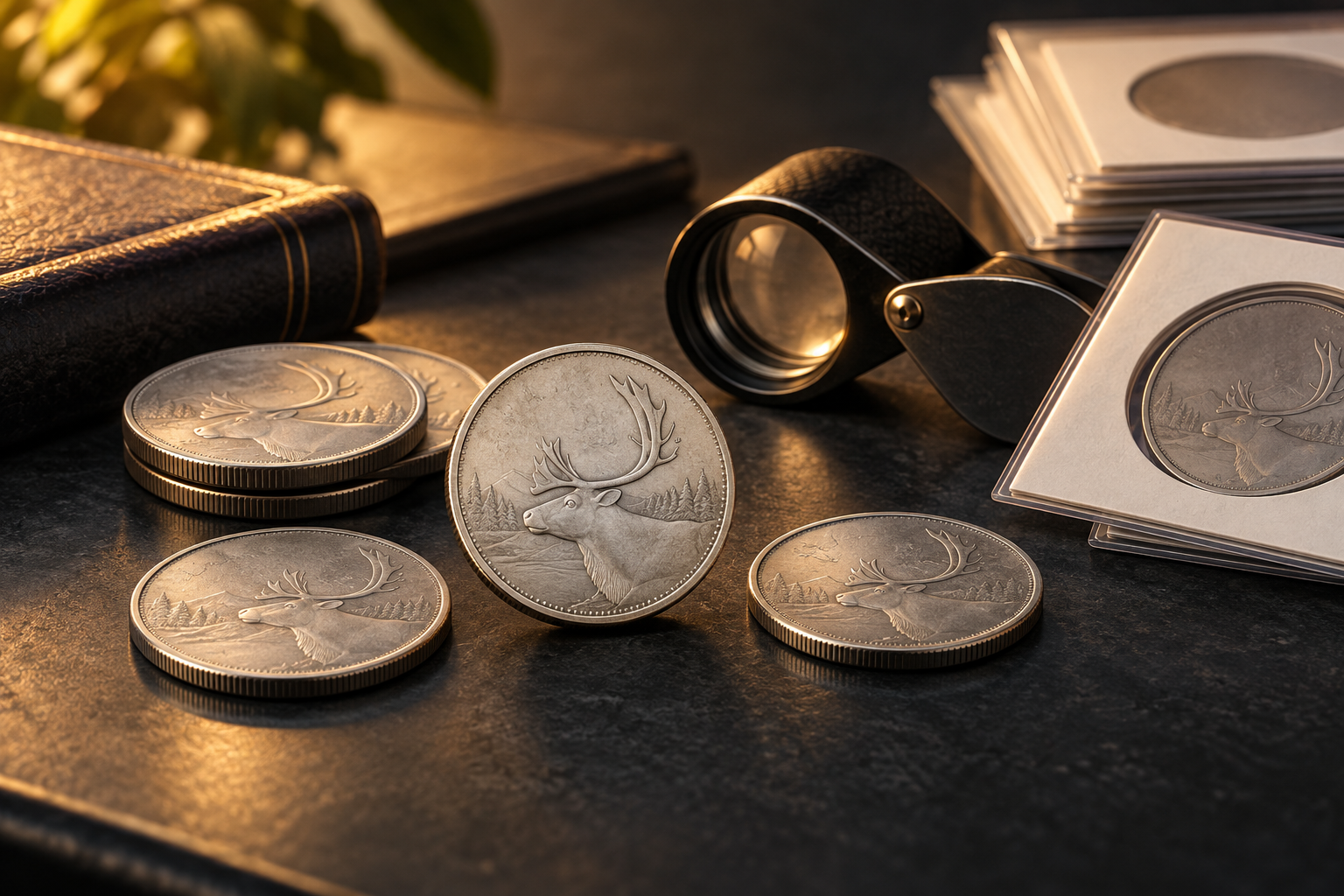
What makes Canadian quarters worth money?
A quarter can command more than face value because of its silver content, collector demand or an authenticated production feature. These reasons can overlap, but they should be assessed separately.
Start by distinguishing three kinds of value:
- Face value: the denomination shown on the coin.
- Metal value: the value of its precious-metal content before a buyer’s deductions.
- Collector value: what a buyer will pay for its particular date, variety, grade and appearance.
A dealer buying common silver coins may assess a group mainly by metal content. A collector considering a scarce variety will care much more about identification and condition.
That distinction helps explain why two coins bearing the same date can attract very different offers. One may be worn and ordinary, while the other has a recognised variety or unusually well-preserved surfaces.
We would also separate an asking price from an actual sale. A seller can advertise a quarter at any amount. That listing does not establish what another buyer will pay.
For broader denomination coverage, our guide to valuable Canadian coins provides a starting point. Here, we focus specifically on quarters.
Canadian quarters worth money: dates and varieties to check
Silver-era quarters, the 1973 Large Bust variety and selected lower-mintage dates deserve closer inspection. None should receive a fixed collector valuation from its date alone.
Use this Canadian quarter value chart as a sorting guide. Its final column identifies the appropriate valuation method rather than assigning an unsupported price to an unseen coin.
| Quarter or group | What to check | How to approach its value |
|---|---|---|
| 1908 to 1919 | Silver composition, date and condition | Assess silver content, then check collector interest |
| 1920 to 1966 | Silver composition and remaining detail | Compare a metal-content quote with any collector premium |
| 1967 centennial | Silver alloy and preservation | Confirm composition before calculating metal value |
| 1968 | Silver issue versus nickel issue | Identify the metal first |
| 1973 RCMP commemorative | Large Bust versus Small Bust | Authenticate the variety before comparing sales |
| 1991 | Condition and strike quality | Compare with the same date and grade |
| Other commemoratives or unusual coins | Exact issue, finish and possible damage | Establish identity before assuming rarity |
The Royal Canadian Mint’s records document the silver transition and list a 1991 mintage of 459,000. A production total is useful context, but it does not tell us how many coins survive in a particular condition. Source: Royal Canadian Mint quarter specifications and mintages.
The 1973 Large Bust quarter
The valuable distinction is on the portrait side, not simply the Mountie design. Coins and Canada identifies the Large Bust through its larger portrait, beads closer to the rim and the relationship between the lettering and beads. Use its reference photographs for comparison rather than judging portrait size from memory. Source: 1973 Large Bust identification.
If yours appears to match, keep it separate for specialist assessment. A blurry photograph or resemblance to a social-media example is insufficient to establish the variety.
Lower mintage does not establish a selling price
The 1991 quarter illustrates why date and condition must be considered together. A circulation-worn example and an exceptionally preserved coin should not be compared as though they were interchangeable.
Before paying for certification, establish whether the likely benefit justifies the assessment, shipping and selling costs. Request a preliminary opinion without assuming that every interesting date needs professional grading.
How silver content affects a Canadian quarter’s value
A silver quarter’s metal value depends on how much fine silver it contains and the current CAD silver price. Its age or silver colour alone cannot provide that calculation.
The broad composition checkpoints are:
| Period | Silver-content checkpoint |
|---|---|
| 1908 to 1919 | 92.5% silver |
| 1920 to 1966 | 80% silver |
| 1967 | Both 80% and 50% silver issues |
| 1968 | Both 50% silver and nickel issues |
The Mint’s composition records and the Bank of Canada’s account of the transition support these distinctions. The Bank specifically documents both silver and nickel quarters dated 1968. Sources: Royal Canadian Mint, Bank of Canada, A History of the Canadian Dollar.
For a confirmed silver coin:
Fine-silver weight × current CAD price in the same weight unit = theoretical metal value.
That result is a reference, not a guaranteed buyback offer. A buyer’s quote can reflect verification, condition, processing costs and resale demand.
Use our live silver price page when assessing metal value instead of treating an old article’s price as current. Our guide to which Canadian coins are silver covers composition across denominations.
Also distinguish older circulation silver from investment-grade bullion for tax purposes. CRA guidance generally requires at least 99.9% purity for silver, or 99.5% for gold and platinum, plus qualifying form and other requirements, for precious-metal GST/HST treatment. Older silver quarters do not meet that silver-purity threshold; confirm the treatment of your transaction with CRA or a tax professional. Source: CRA precious-metals guidance, paragraphs 29 to 34.
How to check condition, varieties and mint errors
Inspect both sides and the edge before deciding that a quarter is rare. Record what you can observe, while leaving uncertain grading or error attribution to a specialist.
Place the coin under good, even lighting. Look for wear on raised details, scratches, corrosion, altered surfaces and any feature that differs from a reliable reference image.
A useful inspection record includes:
- The date and reverse design.
- Clear photographs of both faces.
- A close-up of the suspected variety or error.
- Existing packaging or certification details.
- Visible damage or signs of cleaning.
Separate a variety from an error
A recognised variety is an established difference collectors can identify and compare. A mint error results from something going wrong during production.
A mark acquired after circulation is different again. Scratches, flattened areas or unusual colour do not by themselves establish a collectible mint error.
Describe an uncertain feature neutrally. “Raised line beside the date” gives an assessor something to examine; “rare error worth thousands” assumes the conclusion.
Preserve the surfaces
Do not polish a potentially collectible coin to improve its appearance before assessment. The Canadian Conservation Institute advises against using coin dips and metal cleaners on coins, and recommends careful handling and appropriate storage. Source: Canadian Conservation Institute coin-care guidance.
Hold coins by their edges and keep them separated so their surfaces do not rub together. If a coin is already in a certified holder, photograph the holder and label without opening it.
How to find a realistic CAD value
A realistic valuation comes from comparable completed sales or a current purchase offer. Match the exact coin, condition and selling terms before using another result as a reference.
Search results often mix ordinary circulation coins, specialist varieties, collector finishes and certified examples. Comparing them without checking those differences can produce a misleading estimate.
For each comparable sale, ask:
- Is it the same date and recognised variety?
- Is the condition reasonably comparable?
- Was it a circulation strike or a collector issue?
- Was the coin certified, damaged or cleaned?
- Is the recorded amount in CAD?
- Does it include the buyer’s premium or other charges?
A price-guide entry can help orient your research, but it remains a guide. An auction result records a particular transaction, while a dealer quote reflects what that buyer will pay now.
Avoid converting a foreign auction figure into an apparent current Canadian appraisal. Exchange rates, sale dates and fees can make that comparison unsuitable.
For a group of inherited quarters, request an itemised explanation of the valuation basis. Ask which coins are being assessed for silver and which, if any, warrant a separate numismatic opinion.
If you are unsure whether your collection belongs in a bullion discussion, we offer a free consultation with a sales expert. We can discuss the appropriate next step without assuming that every old quarter should be valued by its silver alone.
How to prepare your quarters for assessment or sale
Sort and document your quarters before requesting an assessment. Keeping possible collector coins separate makes the discussion clearer and reduces the chance of treating a special coin as part of an ordinary silver lot.
Create three labelled groups: possible silver coins, possible collector varieties and unresolved coins. Keep any original packaging with the relevant pieces.
For each group, record the count and dates. Photograph anything unusual individually, then retain a copy of that record before handing over or shipping coins.
When requesting a quote, clarify:
- Whether it is based on metal content or collector demand.
- Whether inspection could change the quoted amount.
- Which fees or shipping costs apply.
- How payment and return arrangements work.
- Whether the buyer handles the particular coins you own.
A bullion dealer and a numismatic specialist may assess different parts of the same collection. A recognised collector variety deserves that distinction before it joins a metal-content sale.
For readers whose goal is acquiring silver rather than collecting dates, compare older circulation coins with modern products in our silver collection. Consider purity, purchase premium and resale terms alongside the appeal of the design.
Frequently asked questions
Which Canadian quarters are worth more than 25 cents?
Silver issues, authenticated scarce varieties and genuine mint errors can be worth more than face value. Condition and buyer demand determine any collector premium. Start by identifying the exact coin, then compare relevant completed sales or request an assessment. An unusual design alone does not establish a valuable rarity.
Are 1967 Canadian quarters silver?
Yes. Canadian circulation quarters dated 1967 were issued in both 80% and 50% silver compositions. Confirm which composition you have before calculating metal value. The date alone does not establish a collector premium, and a buyer’s offer may differ from the theoretical value of the silver.
Are 1968 Canadian quarters silver?
Some are silver and some are nickel. Canada changed composition during this period, so a 1968 date does not settle the question. Confirm the issue before applying a silver-value calculation. Colour alone is unreliable, particularly when coins are worn, toned or photographed under different lighting conditions.
How do I identify a 1973 Large Bust quarter?
Compare the portrait side with a reliable variety reference. Examine the portrait, the beads near the rim and their relationship to the lettering. Photograph those details clearly and seek specialist confirmation if the match appears promising. The Mountie design alone does not identify the Large Bust variety.
Should I clean old Canadian quarters before selling them?
Leave potentially collectible coins uncleaned before assessment. Polishing, abrasive rubbing and chemical treatments can alter the surfaces an assessor needs to examine. Handle coins by their edges and store them separately. For an already cleaned coin, describe its condition honestly rather than attempting another treatment to improve its appearance.
Where can I sell old Canadian quarters?
The appropriate buyer depends on what you own. Common silver coins may suit a bullion buyer, while recognised varieties and collector-quality examples warrant a numismatic specialist. Ask whether the buyer assesses silver content, collector value or both, and confirm fees, inspection terms and payment arrangements before proceeding.
Ready to discuss silver coins you are considering selling? Review our sell-to-us service or call +1 (844) 828-4653 to confirm what we can assess. Our only walk-in counter is at 3854 Dougall Ave, Windsor, ON N9G 1X2.
This article is educational content, not financial or tax advice.

CEO and Founder of CanAm Bullion has been dedicated to delivering exceptional value to Canadians since 2017. Driven by a mission to empower Canadians with expert investment advice and education, he has positioned CanAm Bullion as a trusted resource for those seeking to enhance their portfolios with precious metals. Under Michael’s leadership, the company has become synonymous with reliability, knowledge, and dedication, helping Canadians achieve greater financial stability and long-term success.


Share This Article
Choose Your Platform: Facebook Twitter Google Plus Linkedin