

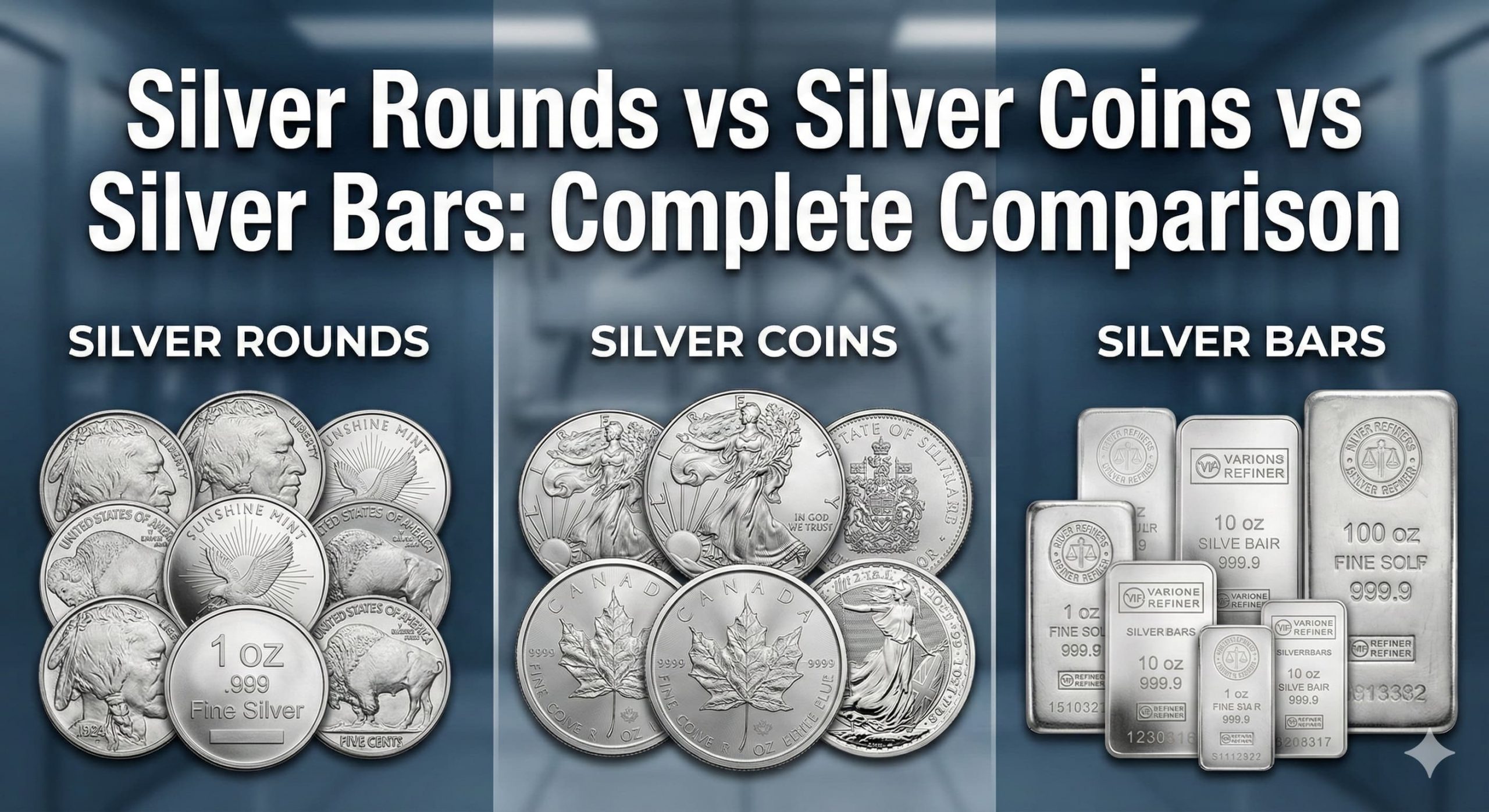
If you’re new to buying silver, you’ll quickly notice that “silver” isn’t just silver. Walk through our online store and you’ll find products labeled rounds, coins, and bars — and the differences between them aren’t just aesthetic. Each format carries different premiums over spot price, different liquidity characteristics, different storage considerations, and different appeal to different types of buyers.
This guide breaks down everything you need to know to make a confident choice. We’ll cover what each format actually is, how they’re priced, how they’re taxed in Canada, and which type of buyer each one is best suited for.
The Basic Definitions
Before diving into comparisons, it helps to get the terminology straight — because “coin” and “round” look nearly identical in hand, yet they’re meaningfully different products.
Silver Coins
A silver coin is produced by a government mint and carries legal tender status in its country of origin. The Canadian Silver Maple Leaf, for example, is issued by the Royal Canadian Mint and carries a face value of $5 CAD. The American Silver Eagle carries a face value of $1 USD. That face value is largely symbolic — no one spends a $5 Silver Maple Leaf at face value when it contains nearly $100 worth of silver — but the government backing it provides is real.
Legal tender status means silver coins are produced under strict government quality control, authenticated by national assay standards, and recognized worldwide. Major government-minted silver coins include:
- Canadian Silver Maple Leaf (Royal Canadian Mint) — .9999 fine silver; annual release with changing security features
- American Silver Eagle (U.S. Mint) — .999 fine silver; one of the world’s most traded silver coins
- British Silver Britannia (The Royal Mint) — .999 fine silver; longstanding UK bullion coin
- Austrian Silver Philharmonic (Austrian Mint) — .999 fine silver; Europe’s best-selling silver coin
- Australian Silver Kangaroo/Kookaburra (Perth Mint) — .9999 fine silver; government-guaranteed purity
Silver Rounds
A silver round is a coin-shaped disc of silver produced by a private mint rather than a government. Rounds are not legal tender. They contain no face value and carry no government guarantee. But they are typically made from .999 fine silver, often closely matching the purity of government coins, and they usually trade at a lower premium over spot price than coins do.
Rounds are where creative design freedom lives in the silver world. Because private mints aren’t bound by government imagery or strict specifications, rounds come in an enormous variety of designs — from the classic Buffalo round to novelty designs like the Bitcoin Round, Trump Round, and many others. They appeal strongly to collectors who want silver content at accessible prices with visually interesting designs.
Silver Bars
Silver bars are rectangular slabs of refined silver, produced by both government mints and private refineries. They range in size from 1 gram to 1,000 oz (1 kg and larger), and their primary design principle is weight efficiency — more silver per dollar spent. Bars generally carry the lowest premiums of the three formats, making them the most cost-effective way to accumulate physical silver by weight.
Common sizes available include 1 oz, 5 oz, 10 oz, 100 oz, and kilo bars. Larger bars carry lower per-ounce premiums, but they come with trade-offs in liquidity and divisibility that are worth understanding before buying.
How Premiums Work — and Why They Differ
Every physical silver product trades at a premium above the spot price of silver. That premium covers the cost of fabrication, distribution, dealer margin, and any branding or collectibility value. Understanding where these premiums come from explains most of the pricing differences between formats.
| Format | Typical Premium Over Spot (1 oz) | Why |
|---|---|---|
| Silver coins (government) | $4–$8 CAD per oz | Government production costs, legal tender status, higher global recognition, security features |
| Silver rounds (private mint) | $2–$5 CAD per oz | Lower production overhead, no government premium, no face value backing |
| Silver bars — small (1–5 oz) | $3–$6 CAD per oz | Simple fabrication, but small sizes still carry per-unit costs |
| Silver bars — large (10–100 oz) | $1.50–$3 CAD per oz | Economies of scale; lower per-ounce production cost |
| Silver bars — kilo+ | $1–$2 CAD per oz | Lowest fabrication premium; institutional-grade product |
Premiums fluctuate with market demand. During periods of high silver demand — like the early 2020 pandemic spike or the 2025 price run — premiums often expand significantly above these ranges because supply can’t keep pace with buying interest. Buying in calmer markets typically gives you better value per ounce.
Purity and Quality
All three formats can deliver excellent silver purity, but there are differences worth knowing about:
- Government silver coins are typically .999 to .9999 fine silver, with the Canadian Silver Maple Leaf setting the standard at .9999 (99.99% pure). They also increasingly include anti-counterfeiting features — the RCM’s Bullion DNA technology, micro-engraved maple leaves, and radial line security backgrounds make modern Silver Maples among the most secure bullion products in the world.
- Silver rounds from reputable private mints are typically .999 fine silver. Quality private mints like Silvertowne, Sunshine Minting, and Scottsdale Mint produce rounds that meet high purity standards, though they don’t include the government-backed authentication features of sovereign coins.
- Silver bars vary by producer. Government mint bars (like RCM silver bars) are typically .9999 fine. Private mint bars from established refineries like Asahi, PAMP Suisse, and Valcambi are .999 or .9999 fine. Bars from lesser-known producers warrant more scrutiny — this is where LBMA approval and assay certification matter most.
For any silver product, the key question is: can its purity be independently verified? Government coins and LBMA-approved bars have the answer built in. With private mint rounds and bars, buying from an established dealer who sources from known, reputable producers is your primary protection.
Liquidity: How Easily Can You Sell?
Silver you can’t easily sell when you want to isn’t a complete investment. Liquidity — how quickly and efficiently you can convert silver back into cash — varies meaningfully across the three formats.
| Format | Liquidity Level | Notes |
|---|---|---|
| Government silver coins | Highest | Globally recognized; any dealer worldwide will buy Silver Maples, Eagles, Britannias. Easiest to resell at full market value. |
| Silver bars (large: 10–100 oz) | High | Well-accepted by most dealers; institutions favor large bars. Some buyers prefer coins for divisibility. |
| Silver bars (small: 1–5 oz) | Moderate-high | Widely accepted but smaller bars carry higher per-unit premiums that can compress resale margins. |
| Silver rounds | Moderate | Most dealers buy standard rounds, but at a larger discount to spot than coins. Novelty or themed rounds may resell at lower rates. |
The liquidity gap between government coins and rounds is most relevant when you’re selling. The premium you paid going in on a Silver Maple Leaf is partially recovered going out, because dealers pay more for government-minted coins. With rounds, you often receive closer to spot price at resale — which is fine if you also paid a lower premium going in.
Storage and Divisibility
Physical format affects how you store and manage your silver, and how flexibly you can deploy it when needed.
Coins and rounds are naturally divisible — each unit is typically 1 oz. You can sell or trade individual coins without breaking up a larger holding. Bars above 10 oz concentrate value in fewer units, which simplifies storage but reduces flexibility. If you hold a 100 oz bar and need to sell 20% of your position, you either sell the whole bar or can’t sell at all.
Kilo and 100 oz bars store the most value per square inch, making them the most space-efficient format. For investors using professional vault storage — where fees are based on space and weight — large bars are generally the most economical option. For home storage, coins and rounds are easier to handle, organize, and partially liquidate without disrupting the rest of your holding.
Tax Considerations for Canadian Buyers
In Canada, investment-grade silver is generally exempt from GST/HST, provided it meets the CRA’s purity threshold of 99.9% silver or higher. This applies to all three formats — coins, rounds, and bars — as long as they meet that standard. Government coins like the Canadian Silver Maple Leaf automatically qualify. Standard rounds and bars from reputable producers also qualify at .999 or .9999 fine.
The exception is numismatic or collectible coins that command significant premiums beyond their silver content — these can attract GST on the portion above bullion value. For most standard bullion products in all three formats, the tax treatment is identical. We ensure every product we carry meets the qualifying purity standard so you’re not paying unnecessary consumption tax on your investment.
Capital gains tax applies when you eventually sell for a profit, regardless of format. Keep purchase records — date, quantity, and price paid — to calculate your adjusted cost base accurately.
Which Format Is Right for You?
There’s no universal right answer, but there are clear patterns based on what buyers are trying to accomplish.
Buy Government Silver Coins If You:
- Prioritize liquidity and want the most universally accepted silver product
- Plan to hold long-term and want maximum resale flexibility
- Value anti-counterfeiting security features
- Are building a portfolio that may eventually include international buyers
- Want to give silver as a gift — coins are the most recognized and impressive presentation
Buy Silver Rounds If You:
- Want to accumulate silver ounces at the lowest possible premium
- Enjoy the collectible/design aspect of silver without paying numismatic premiums
- Are focused on silver content over brand recognition
- Are a newer investor building a position and keeping entry costs low
- Want unique, themed designs not available in government coin formats
Buy Silver Bars If You:
- Are accumulating significant weight and want the lowest per-ounce cost
- Use professional vault storage and want efficient space utilization
- Prioritize cost per ounce over divisibility
- Are a more experienced investor comfortable with less divisible holdings
- Are buying in quantity (10+ oz purchases where bar economics become compelling)
The Case for Mixing Formats
Many experienced silver investors hold all three formats in different proportions. A typical approach is to use large bars as the core holding — where most of the weight sits at low premiums — supplemented by government coins for liquidity reserves and some rounds for accumulation at accessible entry costs.
Think of it like a portfolio within a portfolio: large bars are your long-term, low-cost accumulation. Government coins are your liquid, globally recognized reserves. Rounds let you add ounces economically during buying opportunities. Each format earns its place.
| Investor Profile | Suggested Allocation |
|---|---|
| First-time buyer (under $1,000) | Primarily government coins (Silver Maples or Eagles) for maximum liquidity and recognition |
| Cost-conscious accumulator | Mix of rounds (for low-premium ounces) and small bars (5–10 oz for slightly lower premiums) |
| Serious investor ($10,000+) | Majority in 10–100 oz bars for cost efficiency; 20–30% in government coins for liquidity; optional rounds for variety |
| Collector/investor hybrid | Core holding in coins and bars; rounds for thematic/design interest without numismatic premium risk |
What We Carry at CanAm Bullion
We stock all three formats across a wide range of sizes and producers. Our silver coins include Canadian Silver Maples, American Silver Eagles, British Britannias, Austrian Philharmonics, and more — all sourced from their respective government mints. Our silver bars range from 1 oz to 100 oz, with products from the Royal Canadian Mint, Asahi Refining, Silvertowne, and other established refineries. Our silver rounds include popular designs like the Buffalo Round, Bitcoin Round, and Sunshine Round from trusted private mints.
Every product we carry is verified for purity, properly documented, and fully insured during transit to your door. If you’re unsure which format suits your situation, our team is available at 1-877-513-9399 to talk through your options — no pressure, just straightforward guidance from people who know silver.
Ready to start? Browse our full silver collection and filter by format, size, and mint to find exactly what you’re looking for.

CEO and Founder of CanAm Bullion has been dedicated to delivering exceptional value to Canadians since 2017. Driven by a mission to empower Canadians with expert investment advice and education, he has positioned CanAm Bullion as a trusted resource for those seeking to enhance their portfolios with precious metals. Under Michael’s leadership, the company has become synonymous with reliability, knowledge, and dedication, helping Canadians achieve greater financial stability and long-term success.


Share This Article
Choose Your Platform: Facebook Twitter Google Plus Linkedin