

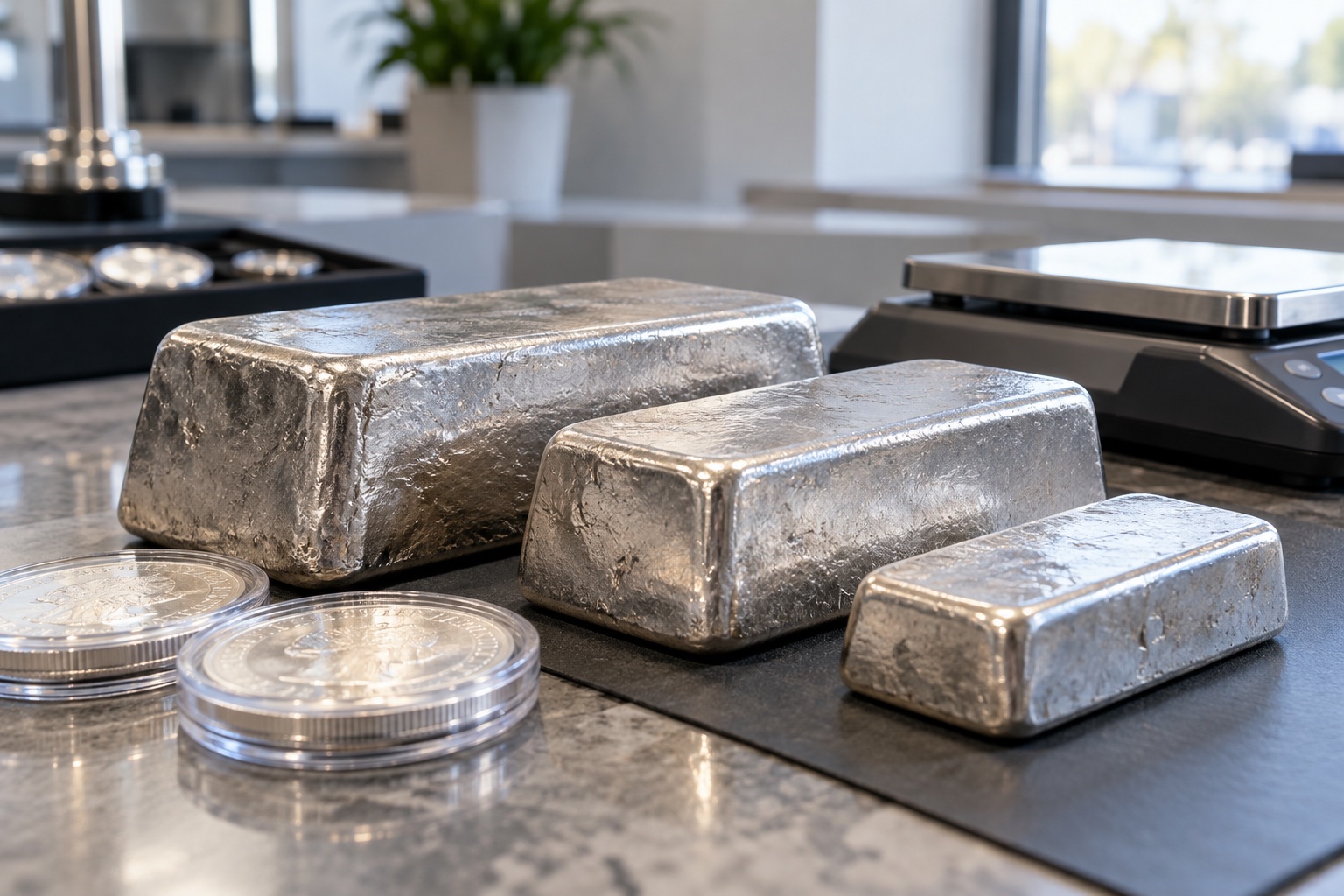
Selling silver in Canada starts with knowing exactly what you own. A tube of Silver Maple Leafs, a 100 oz bar, a box of private-mint rounds, and a collection of older circulating coins all contain silver, but buyers may evaluate them differently.
The most important distinction is the difference between silver's spot price and the amount a buyer will actually pay you. Spot price provides a market reference. Your offer also depends on the product, fine-silver content, condition, demand, authentication, and the buyer's pricing terms.
In this guide, we explain how to organize your silver, estimate its underlying metal value, choose a buyer, compare quotes, and prepare for a sale without confusing a theoretical value with your final proceeds.
Where to Sell Silver in Canada: The Short Answer
For investment silver bars, coins, and rounds, a specialist bullion dealer is a practical starting point. Coin dealers may be more appropriate for pieces with collector value. Jewellers and refiners may handle certain silver objects, while pawn shops and private buyers offer other routes with different terms.
Before accepting an offer:
- Identify the mint, product, weight, purity, and quantity.
- Separate investment bullion from collectible coins and household silver.
- Check silver's current spot price in Canadian dollars.
- Request a quote for your exact products.
- Compare the amount you will receive after applicable costs.
- Confirm authentication, shipping, payment, and identification requirements.
- Keep the purchase and sale records.
There is no single percentage of spot that every Canadian silver buyer pays. Ask for a current product-specific quote rather than relying on an advertised headline.
Step 1: Separate Your Silver Before Requesting a Quote
Start with an inventory. Record quantities and markings without opening sealed packaging unnecessarily.
Useful categories include:
- Government-issued bullion coins, such as Silver Maple Leafs
- Branded silver bars
- Private-mint silver rounds
- Older circulating coins containing silver
- Proof and other collector coins
- Sterling jewellery, flatware, and other objects
- Silver-plated items
These categories should not be treated as interchangeable.
A standard bullion coin is usually assessed primarily as a precious-metal product. A rare coin may have a separate collector premium. Sterling is an alloy, while silver plate is a coating over another material and should not be counted as solid silver.
If you inherited a collection, keep original labels, receipts, and certificates with the pieces. Those records may help identify products that deserve a specialist assessment before they are grouped into a bulk metal sale.
Step 2: Confirm Weight and Purity
Precious-metal prices normally use troy ounces, not the ordinary ounces used for many household measurements.
One troy ounce is approximately 31.1035 grams. A kilogram is approximately 32.1507 troy ounces. An ordinary ounce is approximately 28.3495 grams, so confusing the two produces a misleading estimate.
| Product or marking | What it usually indicates | What to verify |
|---|---|---|
| 1 oz Silver Maple Leaf | One troy ounce of fine silver; .9999 purity | Exact issue, authenticity, quantity, and condition |
| .999 silver bar | 99.9% silver | Whether the stated weight represents gross weight or specified fine content |
| .999 silver round | 99.9% silver | Refiner, stated weight, and authenticity |
| 925 sterling | 92.5% silver alloy | Actual silver-bearing weight and non-silver components |
| Older circulating coin | Composition varies | Country, denomination, year, and issue |
For a product stated to contain one troy ounce of fine silver, use that fine content in your estimate. Do not reduce it again by multiplying by purity.
For an item measured by gross weight, calculate fine content from weight and verified purity. Weighted candlesticks, knife handles, and jewellery with stones need special care because their total weight can include substantial non-silver material.
Step 3: Use Spot Price as a Reference
Check a current silver price in Canadian dollars and note the time. Quotes from different times may reflect market movement rather than a difference in dealer margins.
A basic estimate is:
Fine-silver content in troy ounces × CAD spot price per troy ounce = reference metal value.
That estimate helps you understand the scale of a transaction. It does not promise a particular offer.
A physical product's buyback price can be below, at, or above spot depending on product demand and market conditions. A dealer's retail asking price is another figure again: it includes the terms on which the dealer sells that product to a customer.
Ask: “What will you pay for these specific items today, and what costs would be deducted?”
That question produces a usable number rather than a general market observation.
Step 4: Understand the Per-Ounce Math
Consider a deliberately hypothetical market price of C$50 per troy ounce. This is a round number used to explain the calculation, not a current silver price or a CanAm quote.
| Holding | Fine-silver content used in example | Reference value at C$50/oz |
|---|---|---|
| One 1 oz bullion coin | 1 troy oz | C$50 |
| One bar containing 10 fine troy oz | 10 troy oz | C$500 |
| One bar containing 100 fine troy oz | 100 troy oz | C$5,000 |
| 1 kg gross-weight bar at .999 purity | About 32.1186 fine troy oz | About C$1,605.93 |
Suppose an imaginary buyer offers C$48 per fine ounce for the 100 oz bar. The gross offer would be C$4,800. If a C$40 transaction cost applied, the net proceeds would be C$4,760.
At the assumed C$50 spot price, that net amount is equivalent to 95.2% of the reference metal value.
These numbers describe an example only. They do not establish a normal dealer discount or CanAm's buyback basis. Their purpose is to show how a per-ounce offer and a final net payment relate.
Step 5: Choose a Buyer Suited to the Product
Different buyers serve different purposes.
| Buyer | Potential fit | Questions to ask |
|---|---|---|
| Bullion dealer | Recognized investment coins, bars, and rounds | Which products are accepted, and how are quotes calculated? |
| Numismatic coin dealer | Scarce dates, varieties, proofs, and collections | Is the offer based on collector value or metal value? |
| Jeweller or refinery | Certain jewellery and silver-bearing material | Are there minimum quantities, testing charges, or refining deductions? |
| Pawn shop | Local sale of accepted items | What is the final offer and payment method? |
| Private buyer | Individual transactions | How will identity, payment, authentication, and safe delivery be handled? |
The business category does not establish the best price by itself. Compare the actual terms for your actual silver.
For a standard bullion holding, we recommend beginning with buyers who regularly handle the product. For a potentially valuable collectible, request an assessment before accepting a metal-only offer.
Step 6: Understand Why Coins, Bars, and Rounds Receive Different Bids
Two products containing the same silver can receive different offers.
Government-issued coins have identifiable designs and established markets. Recognized branded bars may also be straightforward for buyers to authenticate and resell. Generic rounds remain silver products, but demand for a particular private mint can vary.
That does not mean every Maple Leaf receives a premium or every generic round receives a discount. Dealer inventory, customer demand, condition, and order size all matter.
The premium paid when you bought a product is not automatically recoverable when you sell it. You may have paid for fabrication, distribution, retail margin, or a temporary shortage that no longer exists.
Ask for separate lines on the quote when a holding contains different formats. A blended offer can be convenient, but it makes it harder to understand how the buyer values each category.
For more background on larger formats, see our silver bar size comparison.
Step 7: Compare Net Proceeds
A higher headline bid does not necessarily produce a higher payment.
Use a simple comparison:
| Item to compare | Buyer A | Buyer B |
|---|---|---|
| Exact products and quantity | Same inventory | Same inventory |
| Gross offer | C$___ | C$___ |
| Testing or handling charges | C$___ | C$___ |
| Shipping and insurance | C$___ | C$___ |
| Net proceeds | C$___ | C$___ |
| Quote expiry or price-lock terms | ___ | ___ |
| Payment timing | ___ | ___ |
| Return terms if assessment changes | ___ | ___ |
Give each buyer the same information and obtain quotes reasonably close together.
If one quote is conditional on inspection, make sure you understand what could change. A preliminary estimate based on your description is not necessarily a binding final price.
Step 8: Plan a Large Silver Sale Before Moving the Metal
Silver is physically bulky relative to its value. A holding exceeding 100 oz can make packaging, transport, and insurance especially relevant.
Contact the buyer before arriving with a large lot or sending a shipment. Confirm whether there are appointment requirements, receiving limits, product restrictions, or special packing instructions.
For a mixed holding, prepare a list showing the number of coins, rounds, and bars. Photograph markings and packaging for your records without making the contents publicly visible.
Do not assume that several parcels are safer or easier than one shipment. Splitting a lot can change costs and coverage. Follow the agreed instructions and confirm how each package will be documented.
For an in-person sale, confirm the current receiving location directly. A business may use different addresses for offices, retail visits, or shipments.
Step 9: Confirm Mail-In Terms
A prepaid label and insured shipping are different things. A label can cover postage without resolving the coverage of precious metals.
Before sending silver, ask:
- Does the shipping arrangement expressly cover bullion?
- What value is covered, and when does coverage begin and end?
- Who files a claim if a package is lost?
- How should the products be packed and listed?
- When is the price fixed?
- What happens if the received products differ from the description?
- Who pays for a return if no sale is completed?
Keep tracking, dispatch records, the inventory, and the agreed terms.
Ordinary carrier compensation should not be assumed to protect a high-value silver shipment. The agreed insurance and exclusions matter more than the fact that a parcel has tracking.
Step 10: Leave Cleaning Out of the Selling Process
Do not polish silver to make it look newer before obtaining a quote.
Tarnish, milk spots, fingerprints, and scratches are different issues. They do not all have the same implications for a buyer, and cleaning can introduce additional damage.
The Royal Canadian Mint explains that milk spots do not change a silver coin's precious-metal content. Appearance can still affect a product's desirability or premium, especially for collector pieces.
Describe visible condition honestly and let the buyer assess it. A photograph may help with an initial discussion, but it is not a substitute for authentication.
For potentially collectible coins, preserving the original surfaces is particularly important. A shiny cleaned coin can be less attractive to collectors than a naturally toned original.
Step 11: Prepare Identification and Records
Be prepared to provide identification when the buyer's process or applicable rules require it. FINTRAC imposes identity-verification obligations on dealers in specified circumstances; the exact requirements depend on the transaction.
Do not assume that avoiding cash eliminates every identification requirement. Ask what documents are needed before travelling or shipping.
Keep original purchase receipts where available, the sale confirmation, fees, transaction dates, and payment records. These documents also help you reconcile what left your possession with what was purchased.
If you are selling inherited or jointly owned silver, establish your authority to sell it first. Possessing the metal does not necessarily settle ownership or estate questions.
Step 12: Separate Sales Tax From Income Tax
Two different questions often get mixed together: whether a product attracts GST/HST and whether a sale creates a taxable gain.
CRA guidance uses a minimum purity of 99.9% for silver within its precious-metal definition, along with qualifying forms and other conditions. Jewellery, sterling, plated objects, and collector products should not be assumed to receive identical treatment.
That sales-tax framework does not mean profit from selling investment silver is automatically free of income tax. The applicable treatment depends on the facts, including whether the activity is investment-related, personal, or a business.
For a significant sale, ask a Canadian tax professional about your circumstances. Keep the records needed to establish acquisition cost and proceeds. Our Canadian precious-metals tax guide provides related background.
Selling Silver Through CanAm Bullion
If you want to discuss a silver sale with us, start with a product list rather than a parcel. Send the mint or refiner, stated weight, purity, quantity, and condition so we can discuss acceptance and a current quote.
Our published selling guidance describes contacting the team about pricing and arranging delivery or shipping before verification. Confirm the terms for your particular silver lot, including any costs and the expected payment schedule.
Our contact page is the starting point for that discussion. Do not send metal before receiving instructions.
Before You Sell Silver: A Checklist
- Identify every product and quantity.
- Separate bullion, collectibles, sterling, and plated items.
- Confirm weight units and fine-silver content.
- Check a current CAD spot-price reference.
- Request a product-specific offer.
- Compare net proceeds after costs.
- Review price-lock and inspection conditions.
- Confirm delivery, coverage, and return arrangements.
- Prepare required identification.
- Keep purchase, sale, and payment records.
- Consider tax obligations.
- Avoid polishing or altering the silver.
Frequently Asked Questions About Selling Silver in Canada
What percentage of spot do silver dealers pay?
There is no universal percentage. The offer depends on the exact product, market conditions, quantity, condition, and buyer. Compare current quotes and calculate the effective percentage using net proceeds and the same spot reference.
Is it better to sell bars or coins?
Neither is automatically better. Coins allow smaller partial sales, while a large bar is sold as one unit. Different formats may attract different bids, so request separate prices before deciding which part of a holding to sell.
Can I sell generic silver rounds?
Many bullion buyers assess recognized private-mint rounds, but acceptance is dealer-specific. Provide the mint, weight, purity, and quantity, and confirm acceptance before shipping.
Does tarnish make silver worthless?
No. Surface changes do not mean the silver has disappeared. Appearance can affect premiums or buyer interest, however, and potentially collectible items should be assessed without cleaning.
Can I sell silver without identification?
Do not assume so. Identification may be required under applicable compliance rules or the buyer's procedures. Ask what documents are needed before starting the transaction.
Can I sell just part of my collection?
Yes, if the buyer accepts the selected items and quantity. Individual coins and smaller bars provide more flexibility than one large bar. Compare the offered prices before choosing which units to sell.
Is selling silver taxable in Canada?
It can be. Income-tax treatment depends on the circumstances, while GST/HST depends on separate product and transaction rules. Keep records and seek advice for your situation.
Should I mail silver before getting a quote?
Contact the buyer first. Agree on accepted products, quote conditions, shipping coverage, receiving instructions, and return terms before the silver leaves your possession.
Make the Sale With the Numbers in Front of You
The useful comparison is what a buyer offers for your specific silver after costs and under clearly understood terms. Begin with an inventory, check the units, and separate bullion from items that may deserve a collector assessment.
Then ask for a current quote and confirm how delivery, authentication, and payment will work. That preparation gives you a much stronger basis for deciding whether to sell a few coins, a single bar, or a larger holding.
Ready to discuss your silver? Contact our team with the product details and quantity to request current selling options.

CEO and Founder of CanAm Bullion has been dedicated to delivering exceptional value to Canadians since 2017. Driven by a mission to empower Canadians with expert investment advice and education, he has positioned CanAm Bullion as a trusted resource for those seeking to enhance their portfolios with precious metals. Under Michael’s leadership, the company has become synonymous with reliability, knowledge, and dedication, helping Canadians achieve greater financial stability and long-term success.


Share This Article
Choose Your Platform: Facebook Twitter Google Plus Linkedin