

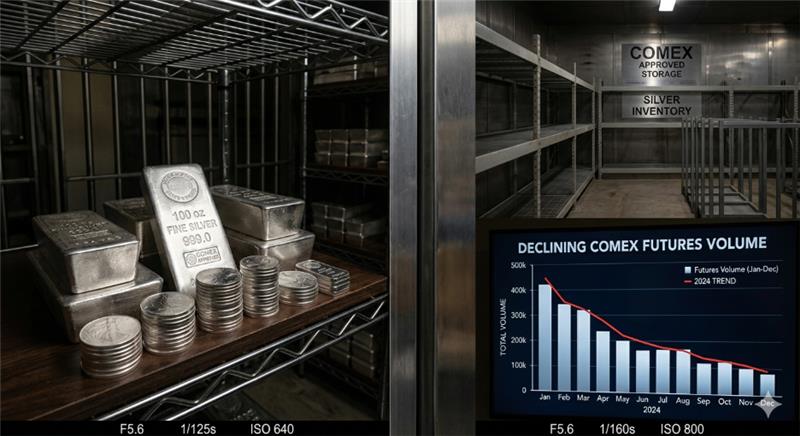

Mid-March 2026 has delivered a masterclass in why physical bullion holders need to understand market structure, not just price charts. While headlines focus on day-to-day swings—silver trading around $81-$84 per ounce this week after touching $87 earlier in the month—the real story is playing out behind the scenes.
If you buy gold or silver as a long-term store of value, what’s happening in futures exchanges, vault inventories, and the physical supply chain right now matters more than the spot price on your screen.
The Futures Market Is Running on Fumes
Here’s something that doesn’t happen often: silver futures trading volumes on the Comex exchange have collapsed to negligible levels, with open interest sitting at 20-year lows.
Understanding Open Interest Collapse
| Metric | Current Status | Significance |
| Open Interest | 20-year lows | Historic decline |
| Registered Silver Stocks | 15,720 contracts | Available for delivery |
| Total Open Interest | 115,854 contracts | Outstanding contracts |
| Delivery Squeeze Ratio | 7.4:1 | Physical shortage risk |
Open interest represents the total number of outstanding futures contracts—essentially, the market’s depth and liquidity. When open interest drops this low while prices remain elevated, it tells you something critical: speculators have largely left the building.
The professional traders who normally provide liquidity to these markets aren’t interested in taking positions at current levels. They’re sitting on the sidelines.
The April Delivery Squeeze Setup
Meanwhile, someone has been quietly accumulating April delivery contracts. With registered silver stocks (metal available for immediate delivery) down to just 15,720 contracts against total open interest of 115,854, the physical squeeze is real.
When buyers demand delivery and vaults don’t have enough metal to satisfy those demands, prices tend to move—and not in small increments.
The Physical Market Tells a Different Story
While futures traders retreat, the physical market remains tight. In both London and Shanghai, silver liquidity continues to be constrained.
Shanghai Premium Signals Physical Scarcity
| Market | Price Level | Premium/Discount | Signal |
| London Spot | $83.97/oz | Baseline | Reference price |
| Shanghai Physical | ~$95/oz | +13% premium | Physical shortage |
| Futures vs. Spot | Backwardation | Spot > Futures | Urgent demand |
As of March 13, 2026, silver was trading at $83.97 per ounce, but in Shanghai, buyers were paying a premium of approximately 13% over London spot prices—a clear signal that physical metal is harder to come by in Asia than paper contracts suggest.
What Backwardation Really Means
Even more telling: Shanghai silver futures have been in backwardation during the week. Backwardation means the spot price (what you pay for immediate delivery) is higher than the futures price (what you’d pay for delivery months from now).
Why This Matters:
- Normal Market: Futures trade at premium to spot (storage costs, time value)
- Backwardation: Spot trades higher than futures (urgent physical demand)
- Signal: Physical supply chain under stress
- Implication: Market saying metal is scarce now
When backwardation appears, it signals urgent physical demand—buyers willing to pay more for metal now rather than wait. It’s the market’s way of saying the physical supply chain is under stress.
Gold Takes a Breather Amid Geopolitical Turbulence
Gold has pulled back modestly this week, trading around $5,095 per ounce—down roughly $76 from the previous week’s close.
Understanding the Dollar Reflex Trade
| Event | Market Response | Duration |
| Initial Crisis News | Flight to USD | Short-term reflex |
| Second-Order Effects | Back to hard assets | Strategic positioning |
| Current Phase | Dollar strength | Temporary headwind |
The immediate trigger has been a short-term flight to the dollar as markets digest the escalating Middle East conflict and its potential economic consequences. This is textbook crisis behavior: when bad news hits suddenly, global liquidity tends to rush into U.S. dollars first.
It’s a reflex trade, not a strategic shift. Once the initial panic subsides and investors begin thinking through second-order effects—higher oil prices, supply chain disruptions, inflationary pressures—capital typically flows back into hard assets that don’t depend on any government’s balance sheet.
Oil Prices and the Inflation Connection
The geopolitical backdrop matters more than many investors realize. With oil analysts now expecting sustained prices above $100 per barrel—and some projecting significantly higher levels if Middle East tensions continue—the inflationary implications are profound.
The Cascading Effects of Oil Shocks
Oil’s Economic Reach:
- Feeds into an estimated 45,000 products across the global economy
- Impacts plastics, fertilizers, transportation costs
- Creates cascading supply chain price increases
- Not a one-month headline risk—structural shift taking months or years
And here’s the challenge for central banks: they’re already dealing with economies showing signs of stagnation. The UK’s 10-year government bond yield has risen nearly 50 basis points recently, even as the economy flatlines. Germany’s yields are hitting new highs while their industrial base struggles.
This combination—slowing growth and rising inflation pressures—creates an environment where traditional policy tools stop working the way they’re supposed to.
Why Bond Markets Are Starting to Crack
Bond yields rising during economic weakness is not normal. This signals something more troubling: markets losing confidence in the purchasing power of currency itself.
The Bond Market Warning Signal
| Normal Market | Current Situation | Implication |
| Growth slows → yields fall | Growth slows → yields rise | Currency confidence eroding |
| Safe-haven buying | Safe-haven selling | Inflation concerns dominant |
| Government support | Market resistance | Debt sustainability doubts |
Governments need lower interest rates to service their debt loads. Central banks want lower rates to support their economies. But if markets don’t believe inflation is under control—or worse, if they believe currency debasement is the only way governments can navigate their fiscal challenges—they demand higher yields as compensation.
This is the dynamic gold and silver investors need to watch. Not daily price fluctuations, but the structural forces that determine whether fiat currencies can maintain their value over time.
The Credit Expansion That’s Coming
Here’s where monetary theory meets market reality. Economists in both the monetarist and Austrian traditions have long argued that oil shocks don’t cause inflation by themselves—it’s the expansion of credit to pay for higher oil prices that does the damage.
The Central Bank Response Cycle
What’s Coming:
- Oil Prices Rise: Sustained above $100/barrel
- Credit Demand Increases: Businesses need financing for higher costs
- Commercial Banks Hesitate: Stressed loan portfolios, deteriorating outlook
- Central Banks Step In: Expand balance sheets to provide liquidity
- Currency Supply Expands: At precisely the moment inflation concerns resurface
For precious metals, this creates a uniquely favorable backdrop. When currency supply expands, bond yields rise, and economic growth stalls, assets that exist outside the traditional financial system—like physical gold and silver—tend to preserve purchasing power better than most alternatives.
What J.P. Morgan Is Forecasting
The institutional view on silver remains constructive despite recent volatility. J.P. Morgan Global Research projects silver prices averaging $81 per ounce in 2026—more than double the 2025 average.
Silver’s Unique Demand Profile
| Silver Characteristic | Gold Comparison | Investment Implication |
| Industrial Use | Primarily monetary | Structural demand floor |
| Supply Deficit | Fifth consecutive year | Physical scarcity growing |
| New Mine Timeline | 7-15 years | Supply can’t respond quickly |
| Dual Nature | Single purpose | Multiple demand sources |
The bank’s analysis highlights something critical: silver’s dual nature as both an industrial metal and a monetary asset creates unique supply-demand dynamics. While gold serves primarily as a store of value, silver’s extensive use in solar panels, electronics, and other high-tech applications means it faces structural demand that doesn’t disappear during economic slowdowns.
Combined with constrained mine supply—new silver projects require 7-15 year lead times to bring online—the physical market faces a fifth consecutive year of structural deficit. That’s not a short-term imbalance. It’s a supply constraint that takes years to resolve.
The Dollar’s Safe-Haven Status Won’t Last Forever
Right now, the dollar index has surged as investors seek perceived safety amid geopolitical chaos. This is creating short-term headwinds for dollar-denominated commodities like gold and silver.
The Safe-Haven Trade Rotation
Current Phase (Days to Weeks):
- Initial shock drives dollar strength
- Precious metals face temporary headwinds
- Reflex trade dominates positioning
Next Phase (Weeks to Months):
- Markets price in longer-term consequences
- Persistent oil shocks and inflation concerns
- Safe-haven trade shifts to hard assets
- Precious metals benefit significantly
Once markets move past the initial shock and start pricing in the longer-term consequences—persistent oil shocks, expanding central bank balance sheets, rising government deficits, deteriorating economic conditions—the safe-haven trade shifts.
The question isn’t whether gold and silver will respond. It’s when.
What This Means for Your Portfolio
For Canadian investors who hold physical bullion as a long-term hedge, this environment reinforces the original thesis. Gold and silver aren’t held for quarterly performance or day-to-day gains.
Why Physical Precious Metals Matter Now
The Current Setup:
- Tight physical markets with low inventories
- Low speculative interest in futures (potential bottom signal)
- Rising bond yields during economic weakness (currency confidence issue)
- Expanding central bank balance sheets (monetary expansion)
- Geopolitical instability (traditional safe-haven driver)
This is exactly the environment where precious metals have historically performed their wealth preservation function.
Putting Recent Performance in Perspective
| Metal | Current Price | 1-Year Gain | Context |
| Silver | $80.31/oz (Mar 16) | +$46/oz | Despite recent volatility |
| Gold | ~$5,095/oz | Above $5,000 | Unthinkable 2 years ago |
Silver stood at $80.31 per ounce on March 16, 2026, still representing a gain of more than $46 over the past year despite recent volatility. Gold, while pulling back modestly this week, remains above $5,000 per ounce—a level that seemed unthinkable just two years ago.
Look Beyond the Noise
Short-term price swings will always grab headlines. But the structural story—depleting inventories, constrained supply, expanding monetary bases, rising geopolitical risks, and deteriorating confidence in fiat currency systems—hasn’t changed.
The Forces That Won’t Resolve Quickly
Long-Term Drivers Remain Intact:
- Fiscal imbalances across developed economies
- Monetary expansion to address economic weakness
- Geopolitical fragmentation and instability
- Supply constraints requiring years to address
- Bond market stress signals
- Oil-driven inflation pressures
If anything, these dynamics are intensifying rather than dissipating.
For those looking to buy gold and silver as part of a balanced, long-term strategy, understanding these underlying dynamics matters more than trying to time daily price movements.
Once the current flight into the dollar subsides and markets begin pricing in the longer-term implications of what’s unfolding, the rush back into precious metals could be significant. And when it comes, investors who maintained their positions through the volatility—or added to them during pullbacks—will likely be glad they did.
Protect Your Wealth with Physical Precious Metals
At CanAm Bullion, we help Canadian investors navigate precious metals markets with clarity and confidence. Whether you’re exploring silver investing for the first time or strengthening an existing position, we provide the expertise and products you need to build a resilient portfolio for uncertain times.
We offer transparent pricing on physical gold and silver bullion, expert analysis of market structure and fundamentals, secure delivery across Canada, and strategic guidance for long-term wealth preservation.
The structural forces supporting precious metals—tight physical markets, monetary expansion, geopolitical instability, and supply constraints—are intensifying rather than resolving. Position your portfolio accordingly.
Ready to strengthen your precious metals position? Visit canambullion.ca or call us at 1-877-513-9399 to speak with our specialists. Let’s discuss how physical gold and silver can protect your wealth through the uncertainty ahead.
References & Data Sources
- Fortune – Current Price of Silver, March 13, 2026 (Daily precious metals market data
- Fortune – Current Price of Silver, March 16, 2026 (Daily silver price tracking and analysis)
- J.P. Morgan Global Research – Silver Price Predictions for 2026 (Institutional forecasts and demand analysis)
- Capital.com – Silver Price Forecast: Middle East Tensions and Market Analysis (March 4, 2026)
- BeInCrypto – Silver Price Prediction for March 2026 (Technical analysis and COMEX data)
- Fortune – Current Price of Silver, March 5-6, 2026 (Market commentary and historical context)
- Alasdair Macleod – Gold and Silver Market Commentary (March 13, 2026) via King World News

CEO and Founder of CanAm Bullion has been dedicated to delivering exceptional value to Canadians since 2017. Driven by a mission to empower Canadians with expert investment advice and education, he has positioned CanAm Bullion as a trusted resource for those seeking to enhance their portfolios with precious metals. Under Michael’s leadership, the company has become synonymous with reliability, knowledge, and dedication, helping Canadians achieve greater financial stability and long-term success.


Share This Article
Choose Your Platform: Facebook Twitter Google Plus Linkedin