

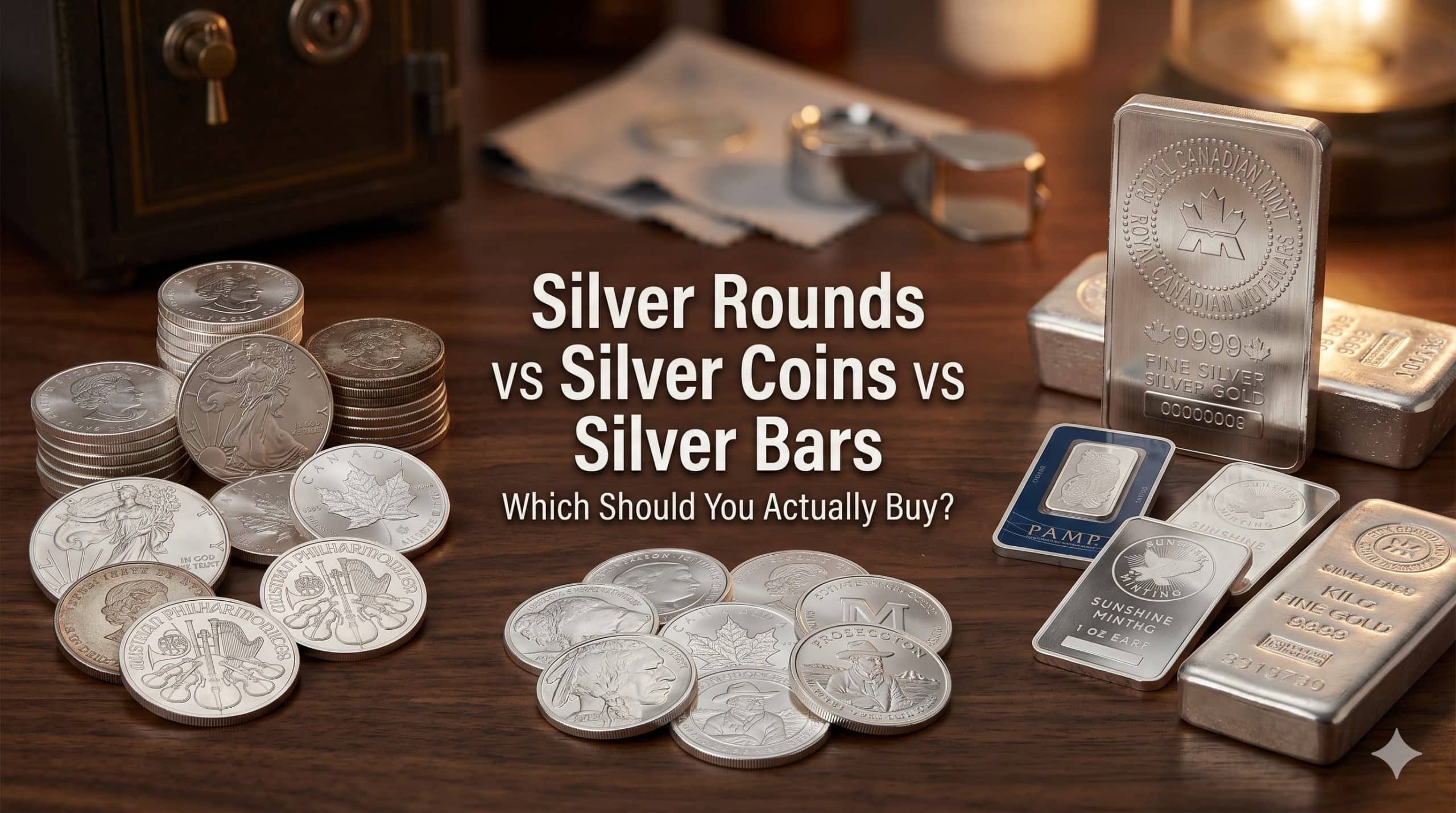
Walk into any online bullion store and you’ll see three categories of silver products: rounds, coins, and bars. They’re all 99.9% silver. They all track the same spot price. But they are not interchangeable — in terms of what you pay to buy them, what you receive when you sell them, and who buys them back without friction. This guide explains the real differences and tells you which product type makes sense depending on what you’re trying to accomplish.
What’s the Difference? Definitions First
Silver Coins
Silver coins are struck by government mints — the Royal Canadian Mint, the US Mint, the Perth Mint, the Austrian Mint — and have legal tender status in their country of issue. The Canadian Silver Maple Leaf is legal tender at $5 CAD face value. The American Silver Eagle carries a $1 USD face value. This legal tender status is largely symbolic (nobody spends a Maple Leaf for $5), but it signals something meaningful: government backing, guaranteed silver content, and strong secondary market demand.
Government coins carry a higher premium over spot than bars or rounds — typically 8–15% for common 1 oz coins at normal market conditions. In periods of tight supply (as seen in 2020 and 2022), premiums on silver coins can spike to 20–30% above spot. The premium is the cost of the government mint’s production, distribution, and the brand recognition that makes them easy to resell anywhere in the world.
Silver Rounds
Silver rounds look like coins. They’re the same size (typically 1 oz), the same shape, and the same purity (99.9%). The critical difference: they’re produced by private mints, carry no legal tender status, and are not issued by any government. They’re sometimes called “private mint silver” or “silver medallions.” Rounds typically carry a lower premium than government coins — usually 5–10% over spot under normal conditions — making them a more cost-efficient way to buy silver by weight.
The tradeoff is liquidity. A Silver Maple Leaf is instantly recognizable to any dealer globally. A round from a lesser-known private mint may require verification before a dealer accepts it, and some dealers simply refuse to buy rounds they don’t recognize. This matters when you decide to sell.
Silver Bars
Silver bars are the most cost-efficient way to own silver by weight. Available in sizes from 1 oz to 1,000 oz (the standard “good delivery” bar), the larger the bar, the lower the premium per ounce. A 100 oz silver bar might carry a 3–5% premium over spot; a 1 oz bar carries 5–10%. Bars from recognized refiners — Royal Canadian Mint, PAMP Suisse, Valcambi, Engelhard — are easily resold. Generic bars from unknown refiners may face the same verification friction as unrecognized rounds.
Side-by-Side Comparison
| Factor | Silver Coins (Govt Mint) | Silver Rounds (Private Mint) | Silver Bars |
|---|---|---|---|
| Typical premium over spot | 8–15% (can spike higher) | 5–10% | 3–8% (size-dependent) |
| Legal tender status | Yes | No | No |
| International recognition | Excellent (Maple Leaf, Eagle) | Varies — known brands only | Good for recognized refiners |
| Dealer buyback ease | Highest — bought anywhere | Medium — varies by mint | High for branded, medium for generic |
| Cost efficiency | Lowest | Middle | Highest |
| Stackability / storage | Good (tubes of 25) | Good (tubes) | Best (flat, dense) |
| Counterfeiting risk | Lowest (security features) | Medium | Low for assayed bars |
| Best for | Liquidity, resale ease | Cost-conscious accumulators | Bulk purchase, lowest cost/oz |
The Canadian Silver Maple Leaf: Why It’s the Default Choice
For most Canadian investors, the Silver Maple Leaf is the right starting point — and often the right ending point too. It’s produced by the Royal Canadian Mint with 99.99% purity (higher than the 99.9% standard), carries a distinctive radial line security feature and a laser-etched micro-engraved privy mark since 2014, and is recognized by every bullion dealer in Canada, the US, Europe, and beyond. When it’s time to sell, there’s no verification friction — it’s identifiable instantly.
Yes, Maple Leafs carry a higher premium than rounds or bars. But that premium is partially recoverable on sale — dealers pay closer to spot for Maple Leafs than for generic rounds, narrowing the effective round-trip cost difference. For investors who want confidence in both buying and selling without friction, Maple Leafs are worth the small premium. Explore our full range of Canadian silver coins including current Maple Leaf offerings.
When Rounds Make Sense
Silver rounds are the right choice when you’re accumulating silver primarily for its weight and you’re confident you’ll sell through a dealer who carries the same brand — or through a private sale to another stacker who recognizes the mint. Rounds from well-known private mints (Sunshine Minting, SilverTowne, Scottsdale Mint) have reasonable secondary market recognition. Generic rounds from unknown sources have poor liquidity and should be avoided unless the premium is exceptionally low.
If your primary goal is owning the most silver possible per dollar spent, rounds from a recognized private mint are a reasonable choice. If your primary goal is owning silver you can sell quickly and easily without any complications, stick to government coins.
When Bars Are the Right Call
Silver bars are optimal for investors making larger purchases — 50 oz, 100 oz, or more — where the premium savings over coins become significant in dollar terms. A 100 oz silver bar at 3% premium versus 100 individual 1 oz coins at 12% premium is a difference of roughly 9% on the purchase — meaningful when silver is at $50+ CAD per ounce. Bars store more efficiently than coins (flat stacking, no tube management) and are straightforward to sell to any dealer at spot if they’re from a recognized refiner.
The practical downside: bars are less divisible. Selling part of a 100 oz position means selling the whole bar and potentially rebuying in smaller units. For investors who want flexibility in partial sales, a mix of bars and coins gives you both cost efficiency and divisibility. Browse our full silver collection to see current bar options alongside coins.
The Counterfeiting Question
Counterfeit silver exists — primarily in rounds and bars from unknown sources purchased through the secondary market (eBay, Craigslist). Tungsten-filled bars, plated rounds, and underweight pieces have all appeared in circulation. The best defence is buying from a FINTRAC-registered, RCM-certified dealer who sources directly from authorized mints and refiners. Every product we carry comes from verified sources — we don’t buy secondary market inventory and resell it as new.
Bottom Line: Which Should You Buy?
- First-time buyer, under 20 oz: Silver Maple Leafs or other government coins — maximum liquidity, minimal friction
- Accumulating aggressively, 20–100 oz: Mix of Maple Leafs and 10 oz bars from RCM or major refiners
- Bulk purchase, 100 oz+: 100 oz bars — lowest premium per ounce, efficient storage
- Private mint rounds: Only from well-known mints, and only if the premium genuinely undercuts comparable coins by more than 3–5%
We are Royal Canadian Mint certified, A+ BBB rated, and carry a 4.9 Google rating. Call us at 1-877-513-9399 before your first silver purchase — we’ll help you match the right product to your goals and budget.

CEO and Founder of CanAm Bullion has been dedicated to delivering exceptional value to Canadians since 2017. Driven by a mission to empower Canadians with expert investment advice and education, he has positioned CanAm Bullion as a trusted resource for those seeking to enhance their portfolios with precious metals. Under Michael’s leadership, the company has become synonymous with reliability, knowledge, and dedication, helping Canadians achieve greater financial stability and long-term success.


Share This Article
Choose Your Platform: Facebook Twitter Google Plus Linkedin