

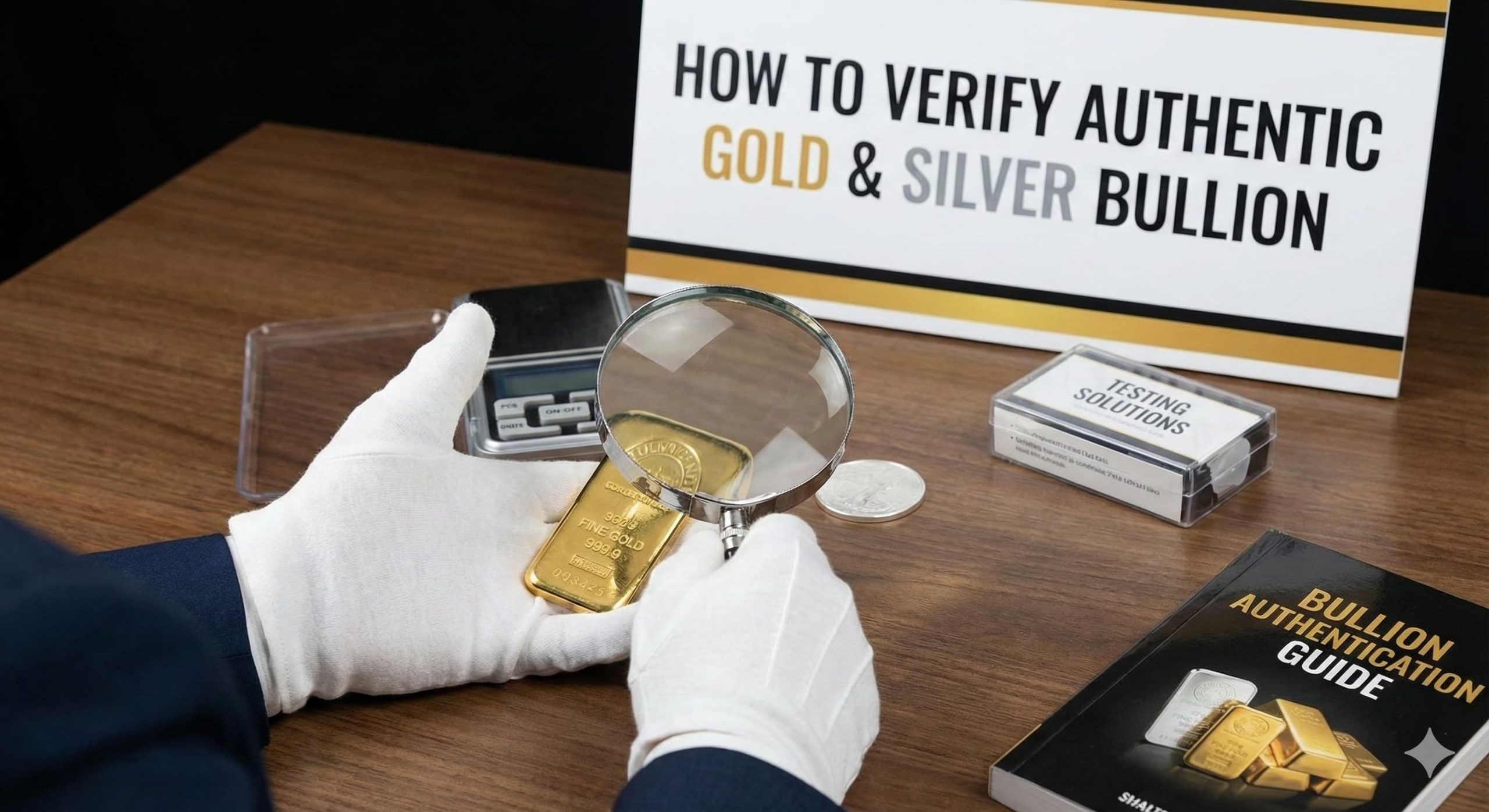
Counterfeit gold and silver bullion represents a serious threat to precious metals investors. As gold prices reach historic highs and silver follows suit, sophisticated counterfeits have flooded the market, making authentication more critical than ever. Whether you’re purchasing your first Canadian Gold Maple Leaf or expanding an existing collection, knowing how to verify authenticity protects your investment from worthless fakes.
The good news? Multiple reliable verification methods exist that anyone can learn, from simple at-home tests to professional authentication services. This comprehensive guide walks you through proven techniques for confirming that your gold and silver bullion is genuine, helping you invest with confidence.
Why Bullion Authentication Matters
The proliferation of counterfeit precious metals stems from several factors. Advanced manufacturing techniques have made creating convincing fakes easier and more profitable. Chinese counterfeiters, in particular, have flooded markets with gold-plated tungsten bars and sophisticated coin replicas that fool casual observers.
Common counterfeit types include:
- Gold-plated tungsten: Tungsten has nearly identical density to gold, making weight-based detection difficult
- Gold/silver-plated base metals: Copper, brass, or lead cores with precious metal plating
- Incorrect purity: Products marked .999 or .9999 containing significantly less precious metal
- Replica coins: Sophisticated copies of popular coins like Maple Leafs, Eagles, and Krugerrands
Buying from reputable dealers like CanAm Bullion—an authorized Royal Canadian Mint dealer with an A+ BBB rating—eliminates most counterfeit risk. However, understanding verification methods remains essential for purchases from other sources, inheritances, or when selling to third parties.
Visual Inspection: Your First Line of Defense
Thorough visual examination reveals many counterfeits before requiring specialized testing. Train your eye to spot the warning signs.
What to Examine on Gold and Silver Coins
| Feature | Authentic Characteristics | Counterfeit Red Flags |
|---|---|---|
| Edge Reeding | Uniform, precisely cut grooves of consistent depth | Irregular spacing, uneven depth, sloppy cutting |
| Design Details | Sharp, crisp lettering and imagery with fine details visible | Blurry letters, soft edges, missing fine details |
| Surface Quality | Consistent finish matching mint specifications | Unusual pitting, unnatural shine, inconsistent texture |
| Color | Characteristic gold or silver hue throughout | Discoloration, copper tinge on edges, inconsistent color |
Advanced Security Features on Modern Coins
Major mints have implemented sophisticated anti-counterfeiting technology. Learning these features helps you verify authenticity quickly.
Canadian Gold Maple Leaf Security Features:
- Radial Lines: Precise lines radiating from the center on both sides create distinctive light-diffracting patterns that change as you tilt the coin
- Micro-Engraved Laser Mark: A tiny maple leaf privy mark containing the last two digits of the year, visible only under 10x+ magnification
- Bullion DNA Technology: Each coin’s unique surface characteristics are digitally recorded for verification by authorized dealers
- Precision Reeding: Exactly 119 reeds on the edge of 1 oz coins, cut to exacting specifications
Canadian Silver Maple Leaf Features:
- Radial lines and micro-engraved laser marks (same technology as gold)
- 99.99% purity mark clearly visible
- Consistent .160″ thickness and 38mm diameter for 1 oz coins
Examine these features under good lighting with at least 10x magnification. Counterfeits may attempt to replicate security features but rarely match the precision of genuine mint production.
Examining Gold and Silver Bars
Bars present different verification challenges than coins. Pay attention to:
- Serial Numbers: Each bar should have a unique serial number. Check that embossing is clean and consistent
- Hallmarks: Refiner marks, purity stamps, and weight specifications should be clearly legible and properly placed
- Assay Certificates: Many bars come with assay cards matching the bar’s serial number. Verify the card matches the bar
- Packaging: Authentic bars often come in sealed packaging from the refiner. Broken seals or tampered packaging warrant extra scrutiny
Learn what authentic bars from major refiners look like. Browse our gold bar collection to see genuine products from the Royal Canadian Mint, Valcambi, Credit Suisse, and other reputable refiners.
Physical Testing Methods
Beyond visual inspection, several physical tests provide additional authentication confidence. These methods range from simple at-home techniques to specialized procedures.
1. Precision Weight and Dimensions
Genuine bullion must meet exact specifications. Even small deviations indicate potential counterfeits.
| Product | Weight | Diameter | Thickness |
|---|---|---|---|
| 1 oz Gold Maple Leaf | 31.11 grams | 30mm | 2.87mm |
| 1 oz Silver Maple Leaf | 31.11 grams | 38mm | 3.29mm |
| 1 oz American Gold Eagle | 33.93 grams* | 32.7mm | 2.87mm |
| 1 oz American Silver Eagle | 31.11 grams | 40.6mm | 2.98mm |
*American Gold Eagles weigh more than 1 oz because they’re 91.67% gold alloyed with copper and silver, but still contain exactly 1 troy ounce of pure gold.
Testing procedure:
- Use a precision digital scale accurate to 0.01 grams (jeweler’s scale)
- Calibrate the scale before testing
- Weigh the coin or bar—it should match specifications exactly
- Use digital calipers to measure diameter and thickness
- Deviations of more than 0.1 grams or 0.2mm warrant further investigation
Why it works: Counterfeiters struggle to match both the correct weight AND correct dimensions simultaneously. Tungsten-cored fakes may have correct weight but wrong dimensions. Base metal fakes may have correct dimensions but wrong weight.
2. Magnet Test (Simple and Effective)
Neither gold nor silver is magnetic. This simple test immediately identifies many counterfeits.
How to perform:
- Use a strong neodymium (rare earth) magnet
- Hold the magnet near your gold or silver
- Observe whether the metal is attracted
Results interpretation:
- No magnetic attraction: Good sign, but not definitive proof (many non-magnetic metals exist)
- Strong magnetic attraction: Definitely counterfeit—gold and silver are not magnetic
- Weak interaction: Some alloyed gold shows slight diamagnetic properties (very weak repulsion), which is normal
Important note: Passing the magnet test doesn’t guarantee authenticity, but failing it guarantees a fake. Use this as a preliminary screening tool, not sole verification.
3. Ping Test (Acoustic Signature)
Genuine gold and silver produce distinctive “ping” sounds when struck gently. Counterfeit base metals produce duller, shorter sounds.
Proper technique:
- Balance the coin on your fingertip (don’t hold tightly—you want it to vibrate freely)
- Using another coin or small metal object, tap the edge gently
- Listen to the sound produced
- Genuine coins produce a clear, high-pitched ring lasting 1-2 seconds
- Counterfeits produce a dull “thud” that dies quickly
Smartphone apps: Several apps analyze the acoustic signature and compare it to known genuine coins. Popular options include “Bullion Test” and “Precious Coin Tester.” While not foolproof, these provide additional data points.
Limitations: This test works best for coins. Bars don’t produce consistent acoustic signatures. Also, practice with known genuine coins to train your ear.
4. Ice Test (for Silver)
Silver has the highest thermal conductivity of all metals. This property enables a simple verification test.
How to perform:
- Place your silver coin or bar on a flat surface at room temperature
- Place an ice cube directly on top of the silver
- Observe what happens
Expected results:
- Genuine silver: Ice begins melting almost immediately due to rapid heat transfer
- Counterfeit: Ice melts much more slowly, similar to other metals
Why it works: Silver’s thermal conductivity is 406 W/(m·K), while copper is 385 W/(m·K) and most other metals are much lower. This noticeable difference makes the ice test surprisingly effective.
5. Density Test (Most Reliable Home Method)
Density testing compares your bullion’s mass-to-volume ratio against known standards. This is one of the most reliable home testing methods.
Required equipment:
- Precision scale (0.01g accuracy)
- Graduated cylinder or overflow container
- Water
- Calculator
Step-by-step procedure:
- Weigh your gold or silver item precisely. Record the weight in grams.
- Fill a graduated cylinder with water and note the exact volume (or use an overflow method)
- Submerge your item completely in the water
- Note the new water level—the difference is your item’s volume in milliliters (ml)
- Calculate density: Density = Weight (g) ÷ Volume (ml)
- Compare to known densities:
- Pure gold (99.99%): 19.3 g/ml
- 22k gold (91.67%): 17.2-17.8 g/ml (varies by alloy)
- Pure silver (99.99%): 10.49 g/ml
- Tungsten (common fake core): 19.25 g/ml
Interpretation:
- Density within 0.1 g/ml of expected value = likely genuine
- Density significantly lower = lighter metal core (definitely fake)
- Density correct but dimensions wrong = possible tungsten core (requires professional testing)
Important limitation: Tungsten-cored gold bars can fool density tests since tungsten (19.25 g/ml) is nearly identical to gold (19.3 g/ml). Sophisticated counterfeits require professional verification.
Professional Authentication Services
For high-value purchases or when home testing raises concerns, professional authentication provides definitive answers.
X-Ray Fluorescence (XRF) Analysis
XRF analyzers determine precise metal composition without damaging the item. This technology shoots X-rays at the sample and analyzes the fluorescent emissions to identify elements present and their concentrations.
Advantages:
- Non-destructive testing preserves item value
- Provides precise purity analysis (e.g., confirms 99.99% vs 99.9%)
- Detects plating over base metals
- Results in seconds
Limitations:
- Only tests surface area (doesn’t detect tungsten cores deep inside bars)
- Expensive equipment (not practical for home use)
Where to get XRF testing: Many bullion dealers, pawn shops, and jewelry stores offer XRF testing services. CanAm Bullion provides professional authentication for customers with concerns.
Ultrasonic Testing
Ultrasonic thickness gauges send sound waves through the metal and measure the return time. Different metals have different sound velocities, revealing internal composition.
Why it’s superior for bars: Ultrasonic testing detects tungsten cores that fool visual, weight, and even XRF tests. The sound velocity through tungsten differs from gold, revealing the deception.
Cost: Professional ultrasonic testing typically costs $25-75 per item. For large purchases or estate inheritances, this investment provides peace of mind.
Fire Assay (Gold Standard)
Fire assay represents the definitive precious metals purity test, used by refiners and mints. The process involves melting the sample and using lead to separate precious metals from impurities.
Key points:
- Destructive testing—small sample must be removed from the item
- Provides exact purity to multiple decimal places
- Used for final verification in disputes
- Expensive ($50-200+ per sample)
When to use: Fire assay makes sense for very high-value items, estate settlements, or when other tests produce questionable results.
Buying from Reputable Sources: Best Prevention
The single most effective counterfeit prevention strategy is purchasing exclusively from established, reputable dealers. This eliminates 99.9% of counterfeit risk.
What Makes a Dealer Reputable
| Credential | Why It Matters | How to Verify |
|---|---|---|
| Authorized Mint Dealer | Direct relationships with Royal Canadian Mint, Perth Mint, etc. | Check mint websites for authorized dealer lists |
| BBB Accreditation | Vetted business practices, complaint resolution | Search Better Business Bureau database |
| Industry Memberships | Professional standards compliance | Look for memberships in precious metals associations |
| Years in Business | Track record of reliability | 10+ years indicates established reputation |
| Customer Reviews | Real experiences from actual buyers | Check Google, Trustpilot, BBB reviews |
CanAm Bullion’s Authentication Guarantee
As an authorized Royal Canadian Mint dealer with an A+ BBB rating and 4.9 Google rating, we provide several authentication assurances:
- Direct Sourcing: We source all gold coins, silver coins, and bars directly from mints and authorized distributors
- Authenticity Guarantee: Every product sold comes with our guarantee of authenticity
- Professional Verification: We use XRF analyzers and other professional equipment to verify all inventory
- Transparent Documentation: Products include proper certificates, serial numbers, and mint packaging
- Buyback Confidence: We confidently buy back products we sold because we know they’re authentic
Red Flags When Buying
Certain warning signs should make you walk away from a deal:
- Too-good-to-be-true prices: Genuine bullion trades near spot price plus reasonable premiums. Prices significantly below market indicate counterfeits
- Unmarked products: Legitimate bullion has mint marks, purity stamps, and often serial numbers
- Pressure tactics: “Act now or lose this price” creates urgency that prevents due diligence
- Unclear sourcing: Inability or unwillingness to explain where product came from
- No return policy: Reputable dealers stand behind their products
- Cash-only transactions: Legitimate businesses accept various payment methods and provide receipts
Special Considerations for Different Products
Verifying Gold Coins vs. Gold Bars
Coins are generally safer because:
- More difficult to counterfeit due to intricate designs
- Security features like radial lines and micro-engraving
- Standard specifications make deviations obvious
- Higher premiums make counterfeiting less profitable
Bars require extra scrutiny because:
- Simpler designs easier to replicate
- Tungsten-cored bars can fool basic tests
- Serial numbers can be faked
- Larger sizes attractive to sophisticated counterfeiters
Silver Authentication Challenges
Silver counterfeiting is less common than gold but still occurs. Silver’s lower value means counterfeits must be produced more cheaply, often resulting in obvious quality differences.
Common silver counterfeits:
- Nickel or aluminum cores with silver plating
- 90% silver items claimed as 99.9%
- Incorrect dimensions or weight
Silver verification advantages:
- Ice test works exceptionally well
- Ping test very effective for coins
- Lower value makes professional testing more cost-effective
View our complete silver bullion collection to see authentic products from major mints.
What to Do If You Suspect a Counterfeit
If testing raises concerns about your bullion’s authenticity:
- Stop using it as collateral or selling it: Knowingly selling counterfeits is fraud
- Document everything: Take photos, record weights/dimensions, save purchase receipts
- Get professional testing: XRF or ultrasonic analysis provides definitive answers
- Contact the seller: Reputable dealers will address concerns and potentially refund/exchange
- Report to authorities if confirmed: Law enforcement and Consumer Protection agencies want to know about counterfeit operations
- Learn from the experience: If buying from that source, understand what went wrong
Building Verification Into Your Buying Process
Make authentication an automatic part of every purchase:
Pre-Purchase Checklist
- ✓ Verify dealer reputation (BBB rating, reviews, years in business)
- ✓ Confirm product specifications match mint standards
- ✓ Review return/exchange policies
- ✓ Ask about authentication guarantees
- ✓ Compare prices—unrealistically low = red flag
Upon Delivery Checklist
- ✓ Inspect packaging for tampering
- ✓ Perform visual inspection under good lighting
- ✓ Weigh and measure against specifications
- ✓ Conduct magnet test
- ✓ Perform ping test (coins)
- ✓ Document with photos and save all paperwork
For Large Purchases
- ✓ All the above plus:
- ✓ Professional XRF testing
- ✓ Ultrasonic testing for bars >10 oz
- ✓ Consider independent third-party verification
Conclusion: Knowledge Is Your Best Protection
Verifying authentic gold and silver bullion combines multiple verification methods, from simple visual inspection to sophisticated professional testing. While no single test provides absolute certainty, using several complementary methods gives you confidence in your precious metals investments.
The three-layer approach works best:
- Buy from reputable dealers with verified credentials and authentication guarantees (eliminates 99%+ of risk)
- Perform basic home testing including visual inspection, weight/dimensions, magnet test, and ping test
- Use professional authentication for high-value purchases or when home tests raise questions
Buy Authenticated Bullion with Confidence
- Shop Verified Products: Browse our gold bullion and silver bullion collections
- Learn More: Read our guide on how to invest in gold
- Expert Guidance: Call 1-844-915-5511 with authentication questions
- See Our Credentials: A+ BBB rating, Royal Canadian Mint authorized dealer, 4.9 Google rating
Protecting your precious metals investment starts with knowledge. Understanding authentication methods gives you confidence whether buying your first ounce or your hundredth. Stay vigilant, test thoroughly, and always buy from trusted sources.
Invest with confidence—your wealth preservation depends on it.

CEO and Founder of CanAm Bullion has been dedicated to delivering exceptional value to Canadians since 2017. Driven by a mission to empower Canadians with expert investment advice and education, he has positioned CanAm Bullion as a trusted resource for those seeking to enhance their portfolios with precious metals. Under Michael’s leadership, the company has become synonymous with reliability, knowledge, and dedication, helping Canadians achieve greater financial stability and long-term success.


Share This Article
Choose Your Platform: Facebook Twitter Google Plus Linkedin